
New white paper: Derisking family office capital by making complexity simple to see, with the barbell strategy and supporting heuristics
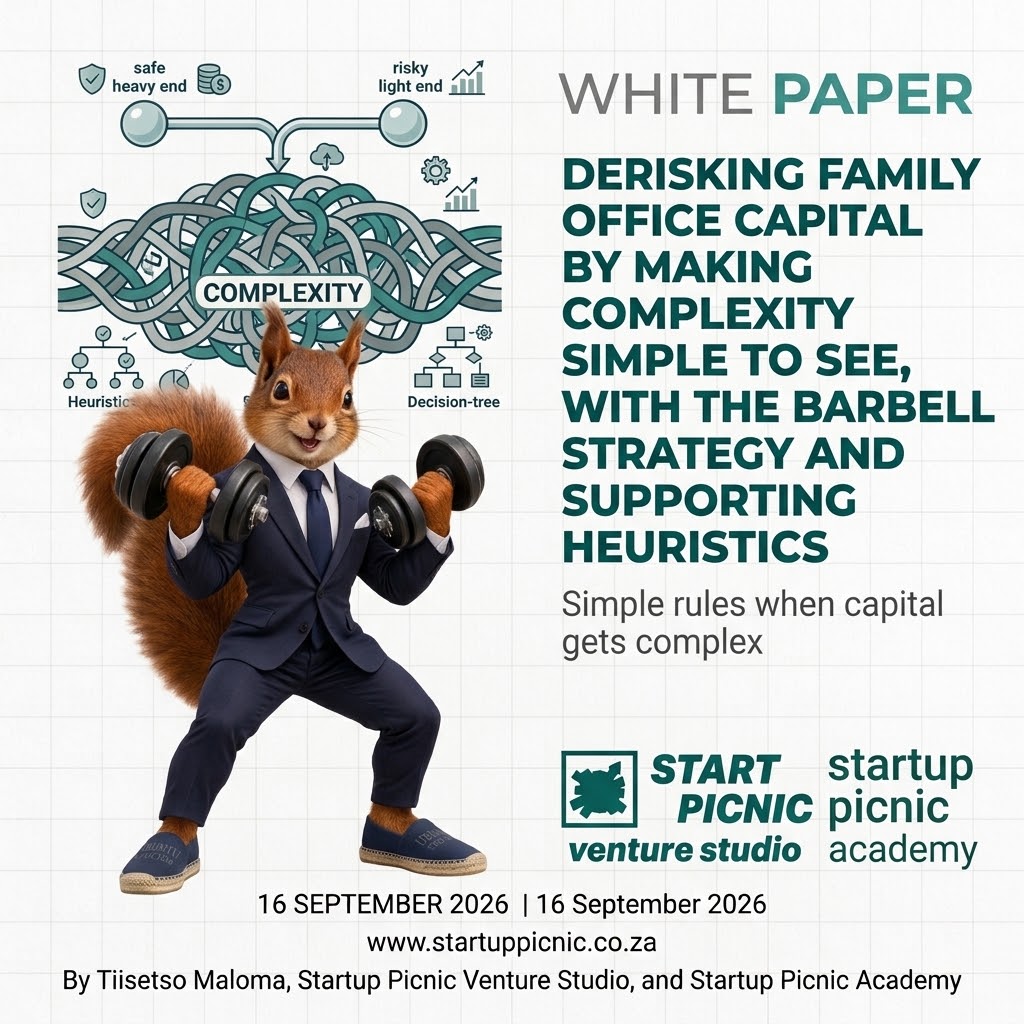
“Derisking Family Office Capital” offers a plain-language lens for capital allocation under uncertainty, using the barbell strategy and supporting heuristics
JOHANNESBURG, South Africa, 16 September 2026 – A new white paper by Tiisetso Maloma, Startup Picnic Venture Studio, and Startup Picnic Academy endeavors to make the problem of family office capital allocation easier to see.
The paper, Derisking Family Office Capital by Making Complexity Simple to See, with the Barbell Strategy and Supporting Heuristics, has two main objectives:
- Explain complexity and uncertainty in simpler terms—using ordinary examples, simple arithmetic, and a story, so that family offices can see why the future is hard to calculate and why the average does not describe what one balance sheet will experience.
- Show the barbell simply—and, importantly, show the supporting heuristics. The barbell is the shape. The supporting heuristics are the habits that keep it honest.
The paper does not argue for or against any particular investment strategy. It does not audit programmes or prescribe allocations. It endeavors to take the difficult, abstract problem of complexity and uncertainty and make it easier to look at.
WHAT IS A FAMILY OFFICE?
A family office is simply an organised way for a family to manage its wealth and related affairs—investments, tax, legal work, philanthropy, succession, administration, and sometimes the operating businesses that created the wealth.
There is no single structure. It can be a large organisation with investment professionals and formal committees, or a principal working with one or two trusted advisers. It can serve one family or several. It can keep functions in-house or outsource them. What matters is the organised way the family manages its capital and long-term interests.
THE PROBLEM, MADE SIMPLE
A family office can choose from many investments. It cannot choose its future sequence of events. It has one balance sheet. It will experience one sequence of capital calls, distributions, gains, losses, taxes, and family decisions. It cannot live through every possible sequence and then receive the average outcome.
“The distinction is simple,” says Tiisetso Maloma, author of the paper and founder of Startup Picnic Venture Studio and Startup Picnic Academy. “An average can describe what happened across a group. A family office has to deal with what happens to it.”
The paper shows why this matters. When outcomes scale without a hard upper limit, when actors adapt and react, and when the order of events shapes what comes next, the average stops telling the whole story. The paper calls this complexity. It does not try to solve complexity. It makes it visible.
THE BARBELL: A SHAPE ANYONE CAN SEE
The paper’s central image is the barbell—the kind used in weightlifting. Heavy weights on both ends, a thin empty bar in the middle. That is the shape the strategy borrows: most capital at a safe end, a smaller portion at a risky end, almost nothing in the middle.
The barbell strategy for investment was made popular by Nassim Nicholas Taleb, a former option trader, probability philosopher and mathematician, and author of The Black Swan and Fooled by Randomness. Many people have written about the barbell for investment. Only a few have written about the barbell and complexity from the perspective of a family office.
The safe end holds what is intended to still be standing after a hard run: cash, short-dated high-quality bonds, and—if it already produces cash—an operating business the family knows how to run. The risky end holds things that can grow a great deal but are volatile: direct companies, venture funds, private equity. The middle holds almost nothing—the moderate products that feel balanced, charge fees, move with volatile assets, and still cannot be sold quickly when cash is needed.
“The barbell is not presented as the right strategy,” Maloma explains. “It is presented as one heuristic for thinking about capital when prediction is limited: preserve the ability to act, while retaining exposure to opportunities that may produce disproportionately large outcomes.”
The paper is careful about what the barbell is not. It is not a 50/50 split. The safe end is not risk-free—inflation, default, and currency risk remain. The risky end is not gambling—each allocation is sized so that failure does not threaten the family’s survival. The exact percentages are a family decision. The direction—most capital safe, a smaller portion risky, almost nothing in the middle—is what defines the shape.
SUPPORTING HEURISTICS: SIMPLE HABITS THAT KEEP THE BARBELL HONEST
The barbell is the shape. The supporting heuristics are the habits that guard it. A barbell can drift. The safe end can quietly become leverage dressed as safety. The risky end can grow until it is the bulk of the book. The middle can fill up with products that feel moderate and cost money to hold.
The paper offers seven supporting heuristics—practical habits drawn from the same starting point—to guard against that drift. They are offered as a perspective for thinking, not as a tested set, and no claim is made that they work together. The office may use one, several, or all of them, as it sees fit.
- Respect the single path (redundancy). The office lives one irreversible sequence. After any plausible shock to the risky sleeve, the larger part of the book must still function.
- Size the risky sleeve so the house remains (half-Kelly). Never allocate more than roughly 10–20% of total capital to any single risk-pole commitment when probabilities are uncertain.
- Stagger the doors. Spread commitments across different years and different types of investments, so that liquidity needs and outcomes do not all arrive at the same moment.
- Prefer what can be understood and sold. A simple operating business with customers is closer to a financed exit than a complex story only a specialist can value.
- Match the book to the generation that must live it. The Chosen One may tolerate more risk in familiar fields. Later decision-makers may need more liquidity and clearer rules.
- Treat local knowledge as a filter, not a forecast. Knowing an industry helps the office recognise a simple firm faster and avoid obvious nonsense. It does not turn uncertainty into risk.
- Watch the middle that pretends to be safe (via negativa). Products that feel moderate, charge for activity, fall when risk assets fall, and still cannot be sold quickly are often the most expensive place to sit.
THE TWO PURSES: A STORY THAT SHOWS A WAY OF THINKING
Central to the paper is a simple fable. A King in the Eastern Cape rewards two longtime helpers with R50 million each. Steve spreads his across balanced unit trusts, life annuities, property funds, hedge funds, and moderate growth portfolios—each reasonable in isolation. When hard times come, everything falls at once. Thabo places R35 million in money market accounts and short-dated government bonds, R10 million in a bakery and taxis he understands, and R5 million in small, risky ventures—each sized so that even total failure would not threaten his family’s home.
“The story does not prove anything,” Maloma notes. “It shows a way of thinking. The question the King asks—which family can still act?—is the question a family office faces.”
TIISETSO MALOMA: EXPLAINING THINGS SIMPLY
Tiisetso Maloma’s passion is explaining things in simple ways. He writes books and develops practical tools that help people ideate, innovate, and launch. His work focuses on complex systems, innovation, township economies, rhetoric, and risk. His publications include Introducing Ubuntu Stoicism, Quick Innovation MBA, Forget the Business Plan Use This Short Model, The Anxious Entrepreneur, Future of Township Economies, Money is Biological, and90 Days to Create and Launch.
This paper continues that work: taking difficult, abstract ideas—complexity, uncertainty, ergodicity, heuristics—and making them easier to see, using ordinary examples, simple arithmetic, and a story.
WHAT THE PAPER DOES NOT DO
The paper is clear about its limits:
- It does not name a winning mix of assets.
- It does not say which jurisdictions to invest in.
- It does not say how to diversify.
- It does not treat listed stocks as a guarantee.
- It does not give mechanics of how to structure a family office.
- It is not investment advice.
“It only says the future is closed, complexity is the setting, and a barbell with clear rules is one coherent way for a family office to stay able to act,” says Maloma.
A SIMPLER WAY TO SEE
The paper uses simple arithmetic, ordinary examples, and storytelling alongside ideas from complexity, uncertainty, and decision-making. The purpose is not to make investing simplistic. It is to make the underlying problem easier to see.
“The final question is not ‘Which strategy is right?'” says Maloma. “It is: given your family’s purpose, time horizon, and circumstances, what perspective best guides your decisions?”
FIND OUT MORE
The full white paper is available for free download at here.
ABOUT THE AUTHORS
Tiisetso Maloma is an entrepreneur, author, and founder of Startup Picnic Venture Studio and Startup Picnic Academy. He writes books and develops practical tools that help people ideate, innovate, and launch. His work focuses on complex systems, innovation, township economies, rhetoric, and risk.
Startup Picnic Venture Studio builds startups at the intersection of intellectual property, finance, technology, and AI.
Startup Picnic Academy builds short courses and practical tools for founders and trainers. It works with corporates, non-profit organisations, and colleges through on-site, mobile, and online formats.
MEDIA ENQUIRIES
Email: info@startuppicnic.co.za
NOTES TO EDITORS
- The full white paper is available for free download at www.startuppicnic.co.za.
- The paper includes extensive references and a detailed fable illustrating each principle.
- Interviews with the author are available upon request.
KEY SOURCES
- Knight, F.H. (1921). Risk, Uncertainty and Profit
- Simon, H.A. (1962). “The Architecture of Complexity”
- Arthur, W.B. (1999). “Complexity and the Economy”
- Gigerenzer, G. (2008). Rationality for Mortals
- Taleb, N.N. (2007). The Black Swan
- Taleb, N.N. (2012). Antifragile
- Kelly, J.L. (1956). “A New Interpretation of Information Rate”
- Peters, O. (2019). “The ergodicity problem in economics”
“Derisking Family Office Capital” offers a plain-language lens for capital allocation under uncertainty, using the barbell strategy and supporting heuristics JOHANNESBURG, South Africa, 16 September 2026 – A new white paper by Tiisetso Maloma, Startup Picnic Venture Studio, and Startup Picnic Academy endeavors to make the problem of family office capital allocation easier to see.…