
R26 Billion Question: New White Paper Proposes Simple Design Test for Funded Entrepreneurship Support | ESD, Incubators and Related Support
“Derisking Funded Entrepreneurship Support Under Complexity” challenges conventional approaches, proposing six practical heuristics to help ensure support money creates more testable value for entrepreneurs.
Download the white paper here.
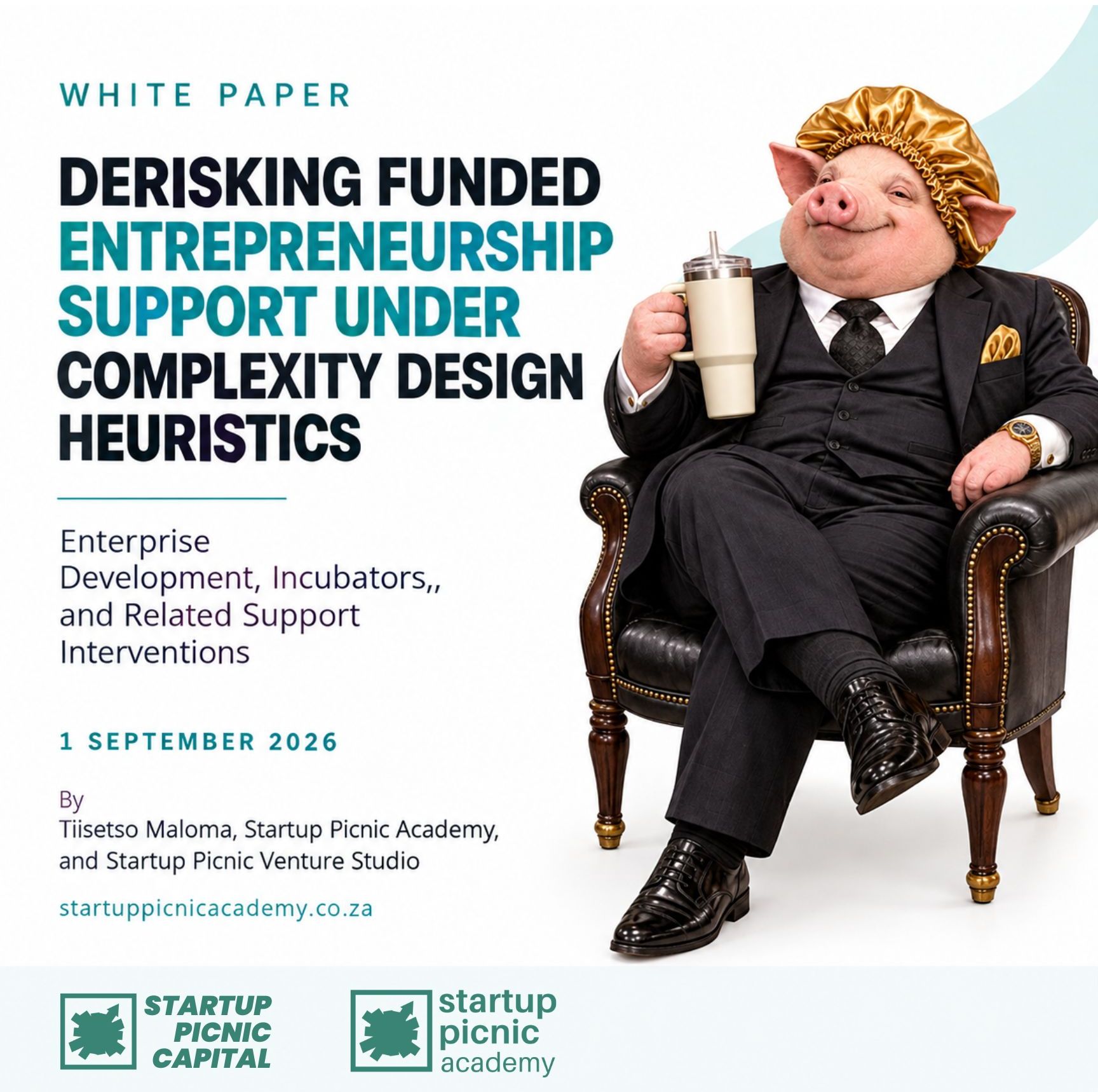
JOHANNESBURG, South Africa, 9 September 2026 – A new white paper by Tiisetso Maloma, Startup Picnic Academy, and Startup Picnic Venture Studio argues that many funded entrepreneurship support programmes risk being designed around administrative requirements rather than entrepreneurial reality.
The paper, Derisking Funded Entrepreneurship Support Under Complexity: A First-Principles Heuristic Guide to Designing Funded Entrepreneurship Support Programmes, arrives as South Africa’s Enterprise and Supplier Development (ESD) ecosystem commits an estimated R26 billion annually. Yet despite the scale, programme results remain inconsistent. Many initiatives report activity—training delivered, mentors assigned, reports filed—without demonstrating lasting gains in firm survival, productivity, or growth.
The Core Problem
“Entrepreneurship does not run on a fixed plan,” says Tiisetso Maloma, author of the paper and founder of Startup Picnic Academy and Startup Picnic Venture Studio. “Customers, competitors, technology, regulation, and personal circumstances keep changing. Information is incomplete. Outcomes cannot be predicted with confidence. In such an environment, more process, more planning, and more administrative control do not automatically produce better results.”
The paper argues that many support programmes are designed around relatively stable administrative structures, while entrepreneurship operates under changing and uncertain conditions. It suggests that this creates a structural design challenge: programmes can become focused on reporting activity rather than building adaptive capacity.
The paper proposes a different starting point: design support from the realities of entrepreneurship itself.
Drawing on established work in complex adaptive systems and decision-making under uncertainty—including Knight (1921), Simon (1955), Holland (1992), Gigerenzer (2008), and Taleb (2018)—the paper offers six simple design heuristics for Funded Entrepreneurship Support (FES), covering Enterprise Development, Supplier Development, incubators, accelerators, and entrepreneurship-focused skills programmes.
Six Design Heuristics of the Paper
The paper proposes six practical design tests:
1. Majority Principle (51%).
Most of the budget should become entrepreneur-controlled value—cash, working capital, equipment, or skills that stay with the founder.
2. Entrepreneur-Controlled Value.
Support should leave the entrepreneur able to act, with enough control and flexibility to make timely decisions.
3. Started-Already.
Prefer founders who have already started—those who have completed at least one cycle of action and market feedback.
4. Time-Average Tactic.
Give selected firms enough resources to try again. Stage support in tranches, releasing further funds when there is a signal.
5. Fast-and-Frugal Training.
Teach a few tactics that can be applied immediately and repeated—act, see the result, adjust—rather than lengthy classroom programmes that delay action.
6. Skin in the Game.
Those who design and deliver support should face consequences tied to whether entrepreneurs receive usable value, not only to whether activities and compliance were completed.
The 51% Fence: A Measurable Test
A central proposal is the 51% Majority Principle: at least 51% of total programme spend should reach entrepreneurs as value they control.
“The 51% is a fence, not a scientific constant,” explains Maloma. “It makes the principle of beneficiary-benefit measurable. If a programme cannot show that most of its budget becomes value the entrepreneur can use, the design deserves scrutiny. The question is simple: where is the money actually going?”
The paper notes that charity accountability standards, such as those from the BBB Wise Giving Alliance and Charity Navigator, typically require 65–70% of expenses to go to programme activities—a useful external benchmark for organisations serious about their stated purpose.
The Gambler Who Understands Complexity
Central to the paper is a recurring fable: the story of the Gambler, whose way of thinking illustrates practical decision-making under complexity, risk, and uncertainty. Through conversations with two entrepreneurs—Fumani and Ami—and the King who funds them, the Gambler examines why support can struggle to create lasting value.
“The Gambler doesn’t pretend to predict the future,” explains Maloma. “He understands that under uncertainty, success comes from placing sensible bets: small enough to survive if they fail, but large enough to learn from if they succeed.”
The paper introduces the Time-Average Tactic, anchored in the Kelly Criterion—a formula for sizing repeated bets. The tranche idea makes this practical: support is released in stages, not as a single lump.
The first tranche funds an initial attempt. If the entrepreneur produces a signal—orders, repeat customers, delivery against specification—the next tranche follows. If not, that capital stays available for another firm.
This preserves the ability to try again; failure of one attempt does not consume the entire opportunity. Each tranche becomes a separate bet, allowing the programme to learn alongside the entrepreneur.
The Fable’s Climax: Two Towers, Two Outcomes
The fable’s climax contrasts two approaches.
In the South Tower, administrators kept more than half the gold for administration—R100,000 of R200,000—and gave Fumani only R20,000 as a one-off payment. The structure gave administrators limited exposure to the consequences of Fumani’s outcome.
In the North Tower, the Adaptari kept only 30% (R60,000) and reserved 70% (R140,000) for Ami. They released the gold in tranches as she planted, sold, learned, and tried again.
They created a peer-learning society called Seed for Adaptation, where entrepreneurs shared experiments and mistakes. They also had skin in the game: if Ami failed, they had no results to show.
“The difference isn’t just about who got more money,” Maloma notes. “It’s about whether the support system itself is designed for learning under uncertainty. The Adaptari treated each tranche as a bet. If the first attempt failed, they learned why and adjusted. If it succeeded, they released more.
“The structure itself—staged, adaptive, and accountable—created room for iteration. The South Tower treated support as a single transaction and called it a programme.”
Heuristics, Not Verdict
The paper is careful to state what it is not.
It does not audit named programmes. It does not calculate a national overhead ratio. It is not a new expenditure study.
The heuristics are not presented as proven causal laws, but as deliberately simple design tests for decision-making under uncertainty—the same conditions entrepreneurs themselves face.
“The imperative is not to spend more on support,” says Maloma. “It is to discover better ways of turning support into entrepreneurial capacity, action, and opportunity.
“This paper offers a way to ask better questions: Is most of this money actually reaching the person doing the work? Does this support strengthen their ability to act, or does it replace their judgement with institutional process? And crucially: is the support system itself designed to learn and adapt, or is it just running a fixed programme year after year?”
About the Authors
Tiisetso Maloma is an entrepreneur, author, and founder of Startup Picnic Academy and Startup Picnic Venture Studio. He writes books and develops practical tools that help people ideate, innovate, and launch. His work focuses on complex systems, innovation, township economies, rhetoric, and risk, with particular attention to how firms, support programmes, and local economies behave when conditions keep changing. His publications include Forget the Business Plan Use This Short Model, The Anxious Entrepreneur, Future of Township Economies, and Quick Innovation MBA.
Startup Picnic Academy designs and delivers short, practical courses and tools for founders and trainers. It works with corporates, non-profit organisations, and colleges through on-site, mobile, and online formats.
Startup Picnic Venture Studio builds startups at the intersection of intellectual property, finance, technology, and AI, and develops infrastructure that enables IP transactions and trading.
Media Enquiries
Email: info@startuppicnic.co.za
Notes to Editors
- The full white paper is available for free download here.
- The paper includes extensive references and a detailed fable illustrating each principle.
- Interviews with the author are available upon request.
Key Statistics Referenced
- ESD resources: R26 billion (B-BBEE Commission, 2023)
- Implementation rate: 61% (B-BBEE Commission, 2023)
- Official unemployment: 32.7% (Stats SA, Q1 2026)
- Youth unemployment (15–34): 45.8% (Stats SA, Q1 2026)
Key Sources
- Knight, F.H. (1921). Risk, Uncertainty and Profit
- Simon, H.A. (1955). “A Behavioral Model of Rational Choice”
- Holland, J.H. (1992). Adaptation in Natural and Artificial Systems
- Gigerenzer, G. & Goldstein, D.G. (1996). “Reasoning the Fast and Frugal Way”
- Taleb, N.N. (2018). Skin in the Game
- Kelly, J.L. (1956). “A New Interpretation of Information Rate”
“Derisking Funded Entrepreneurship Support Under Complexity” challenges conventional approaches, proposing six practical heuristics to help ensure support money creates more testable value for entrepreneurs. Download the white paper here. JOHANNESBURG, South Africa, 9 September 2026 – A new white paper by Tiisetso Maloma, Startup Picnic Academy, and Startup Picnic Venture Studio argues that many funded entrepreneurship support…